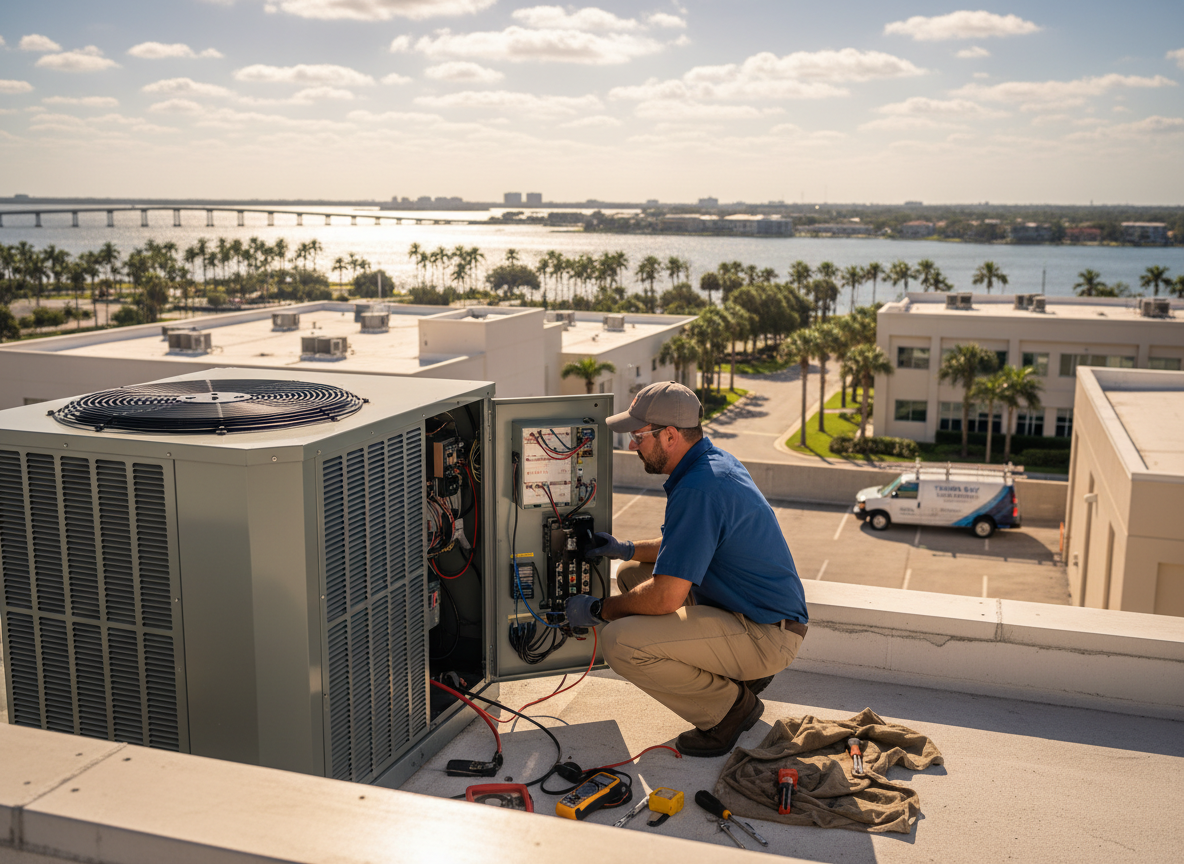
Tampa Bay area homes, especially pre-1990 builds in South Tampa and Ybor City, often run older R-22 systems that leak refrigerant faster in the constant high humidity. Salt air from the bay accelerates coil corrosion on outdoor units in Davis Islands and Pass-a-Grille, turning minor pressure drops into compressor failures during summer peaks. Technicians here check for moisture intrusion in the condensate lines and verify that the attic insulation still meets Hillsborough County energy code after each repair to prevent callbacks.
Storm season brings power surges that fry control boards in units serving single-story ranch homes common in Pinellas County. When a capacitor fails after a lightning event, the entire system can short if the old wiring was never upgraded. Repair calls in these neighborhoods frequently include testing the disconnect box and replacing contactors before the unit is restarted, because skipping that step leads to repeated no-cool complaints once afternoon thunderstorms return.
Coastal properties in Clearwater and Treasure Island face accelerated rust on the outdoor cabinet and fan motor bearings. A tech working these jobs inspects the mounting pad for settling caused by sandy soil and checks that the line-set insulation has not degraded from UV exposure. These details matter because a quick capacitor swap without addressing the underlying corrosion will leave the homeowner calling again within weeks once the next humidity spike hits.
Diagnostic time in older Tampa stock often reveals mismatched indoor and outdoor components installed during previous quick fixes. Bringing the system back to matched SEER performance requires verifying airflow across the evaporator before any refrigerant is added, especially in two-story homes where return ducts run through hot attics.
Technician insight
In Tampa bay area, the thing that catches most people out with HVAC repair near me is how quickly salt air from the bay corrodes capacitors and contactors on units serving homes in Davis Islands and along Bayshore Boulevard. Homeowners often wait until the system stops completely instead of calling when the outdoor fan starts slowing, which lets a fifty-dollar part turn into a compressor replacement once the humidity spikes again.
No-cool call after evening storm
A 1980s ranch in Seminole Heights lost cooling after a thunderstorm. The contactor had welded shut from a surge and the capacitor showed bulging. We replaced both parts, tested the run capacitor on the compressor, cleared the condensate line blocked by algae, and verified the system reached set temperature before leaving.
How it works
- 1
Initial Phone Assessment
Gather symptoms and unit age while confirming service address in the Tampa Bay area.
- 2
On-Site Diagnostic
Test electrical components, pressures, and airflow on the existing system.
- 3
Repair Recommendation
Explain findings and provide upfront pricing before any parts are ordered.
- 4
Completion and Verification
Perform repair, run system through a full cycle, and confirm operation.
Pricing
Diagnostic fee credited toward approved repairs; estimates given before work begins.