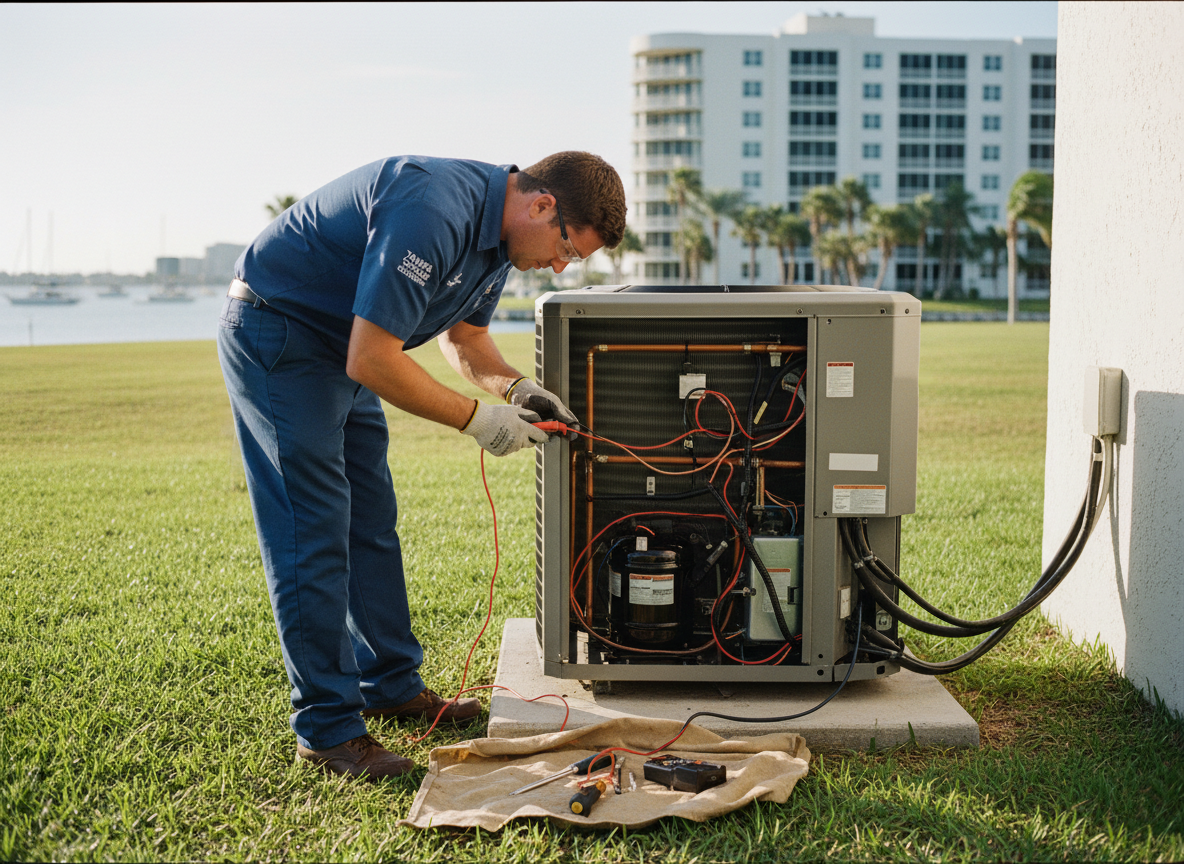
Tampa Bay homes in areas like Hyde Park and Ybor City often feature older ductwork and systems exposed to constant moisture from the Gulf. Technicians at Restexa Labs start every AC repair by checking evaporator coils for salt corrosion and verifying drain line flow to prevent backups that breed mold in high-humidity summers. Hillsborough County building codes require proper refrigerant handling, and crews document pressures and temperatures before any sealed-system work begins.
Frequent calls come from South Tampa and Clearwater properties where afternoon thunderstorms drop heavy loads on condensers already stressed by salt air. A common failure point is the contactor pitting after repeated cycles in 90-plus-degree heat combined with afternoon storms. Restexa Labs carries common OEM parts for Carrier and Trane units prevalent in the area and tests capacitors under load rather than relying on visual inspection alone.
When a thermostat call does not engage the compressor, the process includes verifying 24-volt control wiring runs through attics where insulation can shift and create shorts. In waterfront neighborhoods, ground-level units sit in areas prone to occasional tidal surge or heavy rain pooling, so elevation and disconnect placement receive extra attention during repairs.
Restexa Labs schedules follow-up visits after major repairs to confirm static pressure remains balanced, especially in homes with newer insulation retrofits that change airflow compared to original construction.
Technician insight
In Tampa Bay area, the thing that catches most people out with AC repair is how quickly salt air from the bay pits contactors and coils on units installed near the water in South Tampa or Davis Islands. Homeowners often wait until the system stops entirely instead of addressing early voltage drop readings that show up during our summer afternoon storms.
Hyde Park Compressor Failure
A 1980s home in Hyde Park called after the AC stopped cooling during a humid July afternoon. Inspection found pitted contactor terminals and low refrigerant from a slow leak at the outdoor service valve. The valve was replaced, the contactor swapped, and the system recharged to factory specs. The unit resumed normal operation with restored temperature split.
How it works
- 1
Initial Assessment
Technician arrives and records system model, age, and current error symptoms while noting any visible corrosion from Tampa Bay salt air.
- 2
Diagnostic Testing
Measure refrigerant pressures, electrical draw, and temperature differentials across the evaporator to isolate the fault without guesswork.
- 3
Component Repair or Replacement
Replace or rebuild the failed part such as a capacitor, contactor, or clogged TXV while protecting surrounding surfaces from debris.
- 4
System Verification
Run the unit through a full cycle, confirm proper operation, and clear the drain line to handle local humidity loads.
- 5
Documentation and Advice
Provide written notes on findings and any maintenance steps that address conditions common to Hillsborough County homes.
Pricing
Upfront quotes issued after inspection; final cost depends on parts needed and system access in older Tampa Bay housing stock.